Moreno Valley's Missing Backyards
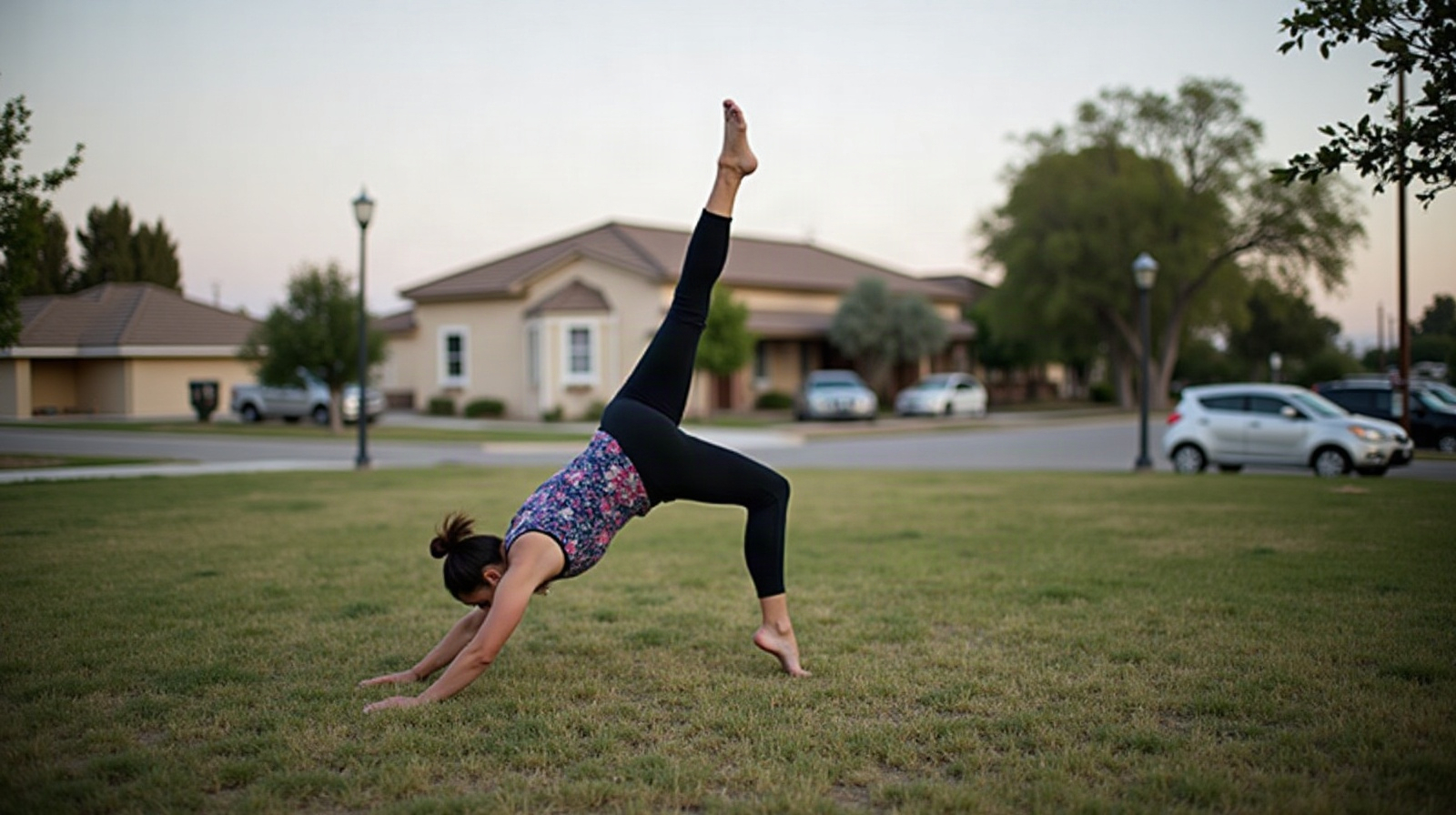
Look closely at what has actually been happening most evenings at Farm House Collective this month, and a stubborn myth about Moreno Valley starts to crack. Yoga at nine in the morning. Tai chi in the same grass patch. A country night with dancing under string lights. An outdoor screening of Matilda for families, followed weeks later by James and the Giant Peach. A touring singer-songwriter. NFL and Dodgers watch parties with food trucks parked out back. Two new small businesses, Purple Box and Homegrown, opening their doors on consecutive days in September. This is not a sleepy exurb with nothing to do but drive to a warehouse job. This is a community showing, in real time, that it wants gathering places, and wants them badly enough to fill a single backyard with retirees, toddlers, twenty-somethings, and football fans on the same weekend.
The uncomfortable part is that this backyard sits in Riverside, not Moreno Valley. That detail matters less as a complaint about geography and more as a diagnostic. It tells us the demand for this kind of third place, informal, mixed-age, cheap or free to enter, was never in doubt. What has been in doubt is whether Moreno Valley itself can produce the conditions for one to exist inside its own limits.
This is where the city's chronic slowness with small commercial permitting stops being an abstract governance complaint and becomes a concrete civic loss. A single collective of events, spun up seemingly with modest resources, has done more to knit together a cross-section of the region in a month than most municipal programming manages in a year. That is not an accident of talent alone. It is also a function of how easy it evidently was, on the Riverside side of the line, to open a venue, add a food vendor, screen a movie outdoors, and let the calendar fill itself in. Moreno Valley's own record with comparably small ventures, a car wash stuck for years in permitting limbo being only the most visible example, suggests the opposite environment: one where opening anything modest and community-facing means a long wait rather than a Tuesday morning phone call.
The instinct in Moreno Valley policy discussions has been to treat land use mostly as a numbers problem, warehouse square footage against housing square footage, tax revenue against traffic counts. That framing misses what a calendar like Farm House Collective's actually proves. People do not just want jobs and rooftops. They want a place to do tai chi on a Thursday and bring their kids to a movie on a Friday and watch a ballgame with neighbors on a Sunday, all within walking or short driving distance, all without needing a state-of-the-art rec center or a six-figure city grant to make it happen. The bar is lower than city planners tend to assume, and the appetite is higher.
None of this requires City Hall to build anything. It requires City Hall to get out of the way faster for the kind of small, mixed-use, outdoor-friendly venues that this model depends on: liquor licenses processed in weeks rather than years, outdoor screening and live music permits that do not require the same scrutiny as a warehouse distribution hub, zoning flexible enough to let a backyard become a gathering spot without a fight. The version of Moreno Valley that could compete with what is happening a few miles away in Riverside is not a hypothetical. It is buildable with the same modest ingredients: a patch of grass, a projector, a few folding chairs, and a permitting office willing to say yes on a reasonable timeline.
The alternative is what the city already has: proof, delivered weekly across the border, that this is exactly the kind of communal life residents want, paired with a permitting culture that keeps ensuring they get it somewhere else. That is not a failure of imagination. It is a failure of speed, and it is the kind of failure a city can actually choose to fix.