What Moreno Valley Screens for Its Children After Dark
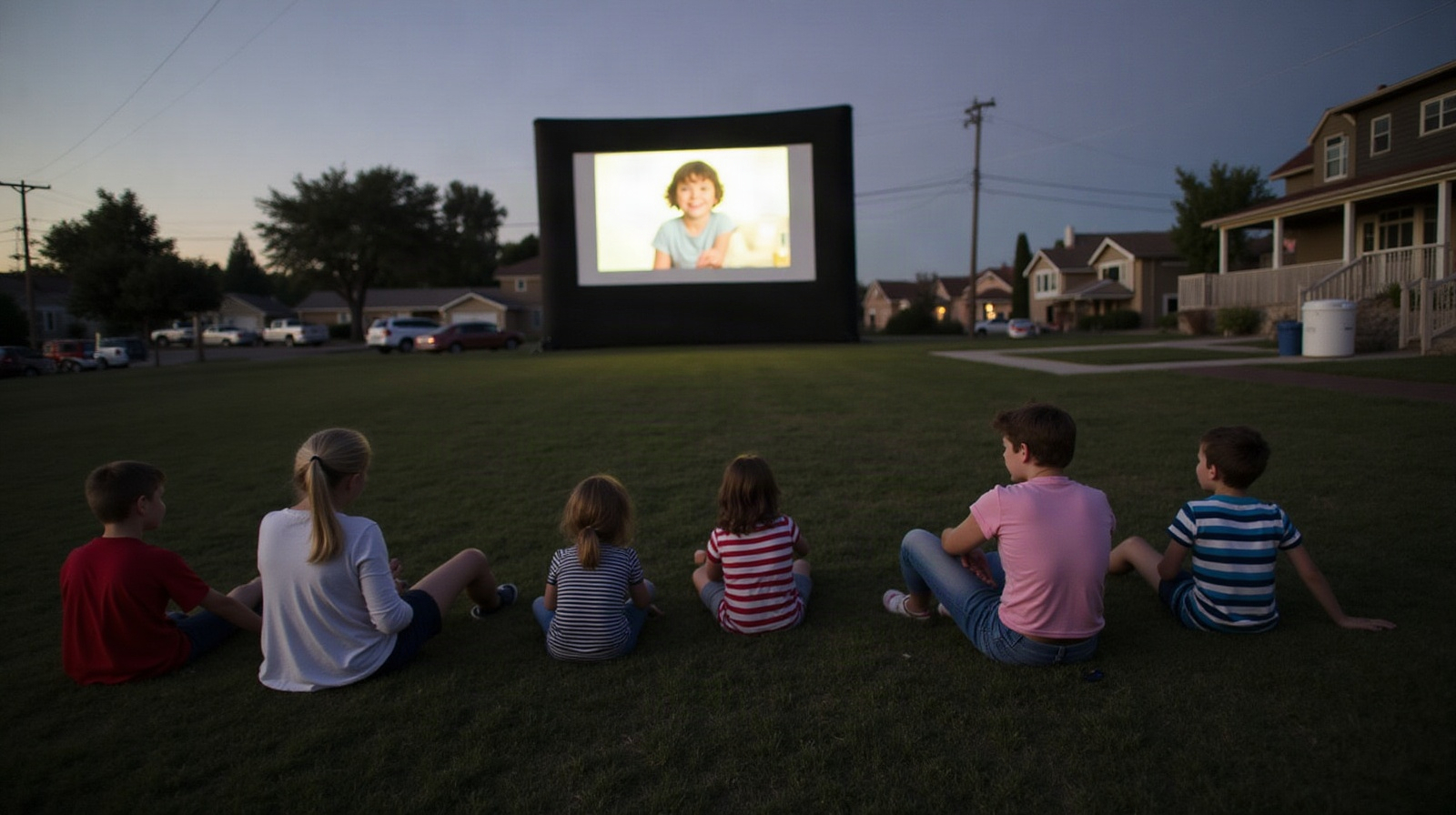
Farm House Collective is running two Roald Dahl adaptations on its outdoor screen this season: Matilda and James and the Giant Peach. Taken separately, they read as unremarkable choices, the kind of family-friendly programming that shows up on lawns and church parking lots across the country every summer. Taken together, though, they share a structure worth pausing on. Both are stories about a child failed, almost comically, by the adults legally responsible for raising them, and both resolve that failure not through the return of a better biological family but through the arrival of a substitute one. Miss Honey takes Matilda in. A society of insects adopts James. The nuclear family, in both cases, is the problem the story has to escape, not the solution it delivers you back to.
This is not a controversial reading of Dahl. Bruno Bettelheim's argument about fairy tales, that children use stories of abandonment and rescue to process real anxieties about their own dependence on flawed adults, applies to Dahl about as cleanly as it applies to the Brothers Grimm. What changes the meaning of a story is not the text but the audience watching it, and it is worth asking what these two films land like on a lawn in the Inland Empire in 2025, rather than on a lawn in, say, Marin County.
Moreno Valley did not build itself around a downtown or a mill or a port. It built itself, over the last three decades, around warehouses. The city sits inside one of the largest logistics economies in the country, and a meaningful share of its working parents keep hours set by fulfillment schedules rather than school bells: overnight shifts, split shifts, mandatory overtime during peak season. None of this is a scandal, and none of it makes anyone a bad parent. But it does mean that a nontrivial number of children in this city are, on any given evening, being looked after by an aunt, a grandmother, an older sibling, a neighbor, someone other than the parent whose name is on the lease. The extended, improvised household is not a plot device here. It is Tuesday.
Which is what makes the Dahl double bill interesting rather than incidental. A film in which a child's actual guardians are indifferent or cruel, and in which rescue arrives from outside the family tree entirely, is not necessarily read as tragedy by an audience that already understands guardianship as something that gets shared out, borrowed, improvised. It might instead be read as confirmation: of course the grownup who saves you doesn't have to be the one who was assigned to you at birth. Bettelheim's child processing anxiety and a Moreno Valley child watching Matilda from a lawn chair while a grandmother who picked them up from daycare that afternoon sits beside them are not having the same experience of the film, even though the film hasn't changed at all.
None of this means Farm House Collective or whoever books its calendar is doing anything deliberate. Dahl adaptations are a default setting for outdoor family cinema precisely because they are cheap to license, widely recognized, and safely nostalgic for the parents making the decision. That is exactly the point worth making: the culture on offer here is imported wholesale, chosen for its market familiarity rather than its fit to place, and it still ends up saying something true about the place anyway. A city doesn't need locally written stories to end up watching its own condition reflected back at it. Sometimes generic programming lands on a real nerve by accident.
The harder question is whether it should keep happening by accident. A region that runs on shift work and shared childrearing has its own stories, its own version of the found-family plot, and none of them require a British boarding-school sensibility or a peach the size of a house to make the point. There is no reason the Inland Empire's cultural life should always borrow its fables about improvised family from somewhere else. Somebody in this region, a teacher, a local writer, a theater kid with a laptop, has the material for the Inland Empire's own Matilda, one set among warehouse shift changes instead of headmistresses. Until that gets written, Moreno Valley's children will keep meeting their own family arrangements secondhand, on a rented screen, in someone else's fantasy of rescue.