Moreno Valley: When Flat, Dry Land Still Needs to Worry About Water
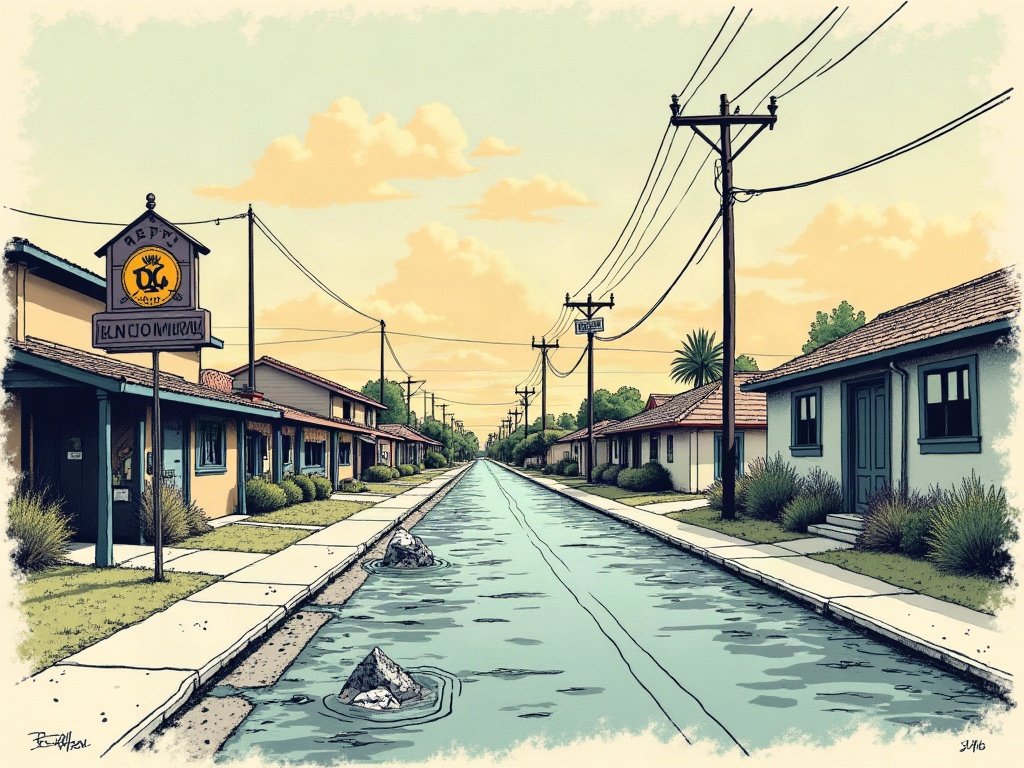
Tucked into the agenda for the Moreno Valley City Council's August 18 meeting, between a discussion of a new city flag and a maintenance contract for elevators, sits a modest line item: drainage projects on Morrison and Merwin streets. Easy to skim past. But that single phrase, “drainage project,” opens onto one of the more counterintuitive facts about living in a desert-adjacent valley: dry places often have the worst flooding.
It sounds backwards. Places that get plenty of rain, like Seattle, rarely see catastrophic street flooding, while places that get relatively little, like the Inland Empire, regularly do. The explanation lives in three overlapping ideas: soil, slope, and storm timing.
Start with soil. In much of the Southwest, including Moreno Valley, long dry spells bake the ground into a hard, compacted surface. When rain finally arrives, especially the sudden, heavy bursts common during the region's summer “monsoon” season from roughly July through September, the water doesn't soak in the way it would into a well-hydrated lawn. It runs off, fast, almost the way it would off a parking lot. Hydrologists sometimes call this reduced infiltration capacity, but the everyday version is simpler: dry dirt can act surprisingly like concrete.
Then there's slope and grading. Moreno Valley sits in a basin ringed by hills, and after wildfires strip vegetation from those slopes, the exposed soil can become temporarily water-repellent, a phenomenon researchers call hydrophobicity, caused by waxy compounds released when organic matter burns. Rain that would normally be slowed by plants and soaked into the ground instead sheets downhill, sometimes carrying ash and debris with it. Add a valley floor, and all that water has to go somewhere. Usually it's the streets.
Which brings up the phrase “100-year storm,” a term that shows up in almost every drainage engineering document and confuses almost everyone who reads it. It does not mean a storm that happens once a century. It means a storm intense enough that, in any given year, there's about a 1 percent statistical chance of it occurring. Run that math over a 30-year mortgage and the odds of experiencing at least one “100-year” storm climb to roughly 26 percent, better than a coin flip's cousin. Engineers design drainage systems, curb inlets, underground pipes, retention basins, around these probability thresholds, essentially betting on how much water infrastructure needs to move before it becomes a liability rather than an inconvenience.
That's what a drainage project on a specific street actually is: an attempt to give fast-moving runoff a predictable path, usually toward a catch basin or detention area, instead of letting it pool against curbs, seep into foundations, or turn an intersection into a temporary lake. It's unglamorous engineering, more plumbing than spectacle, but it's the difference between a hard rain being a minor headache or a genuine hazard.
Here's the part that keeps hydrologists and climate scientists genuinely curious rather than settled: there's growing, though still preliminary, evidence that short, intense downpours are becoming more common in parts of the Southwest even as the region trends drier overall. The logic is straightforward physics. Warmer air holds more moisture, roughly 7 percent more per degree Celsius of warming, according to a well-established relationship called the Clausius-Clapeyron relation. So when a storm does form, it has more water vapor available to dump quickly. Total annual rainfall might not rise, or could even fall, while the rain that does arrive comes in sharper, harder bursts. Researchers are still working out how strongly this pattern applies locally, and it would be premature to treat any single storm as proof of a trend. But it's part of why infrastructure planners increasingly treat old rainfall statistics as a starting point rather than a fixed target.
None of this makes a city council agenda item thrilling reading. But the next time a summer sky over Moreno Valley turns green-gray and dumps half an inch of rain in twenty minutes, it's worth remembering that somewhere underground, a modest network of pipes and basins, the kind approved in meetings like this one, is quietly doing the unglamorous work of keeping that water where it belongs.