Bingo Doesn't Owe You a Win Tonight
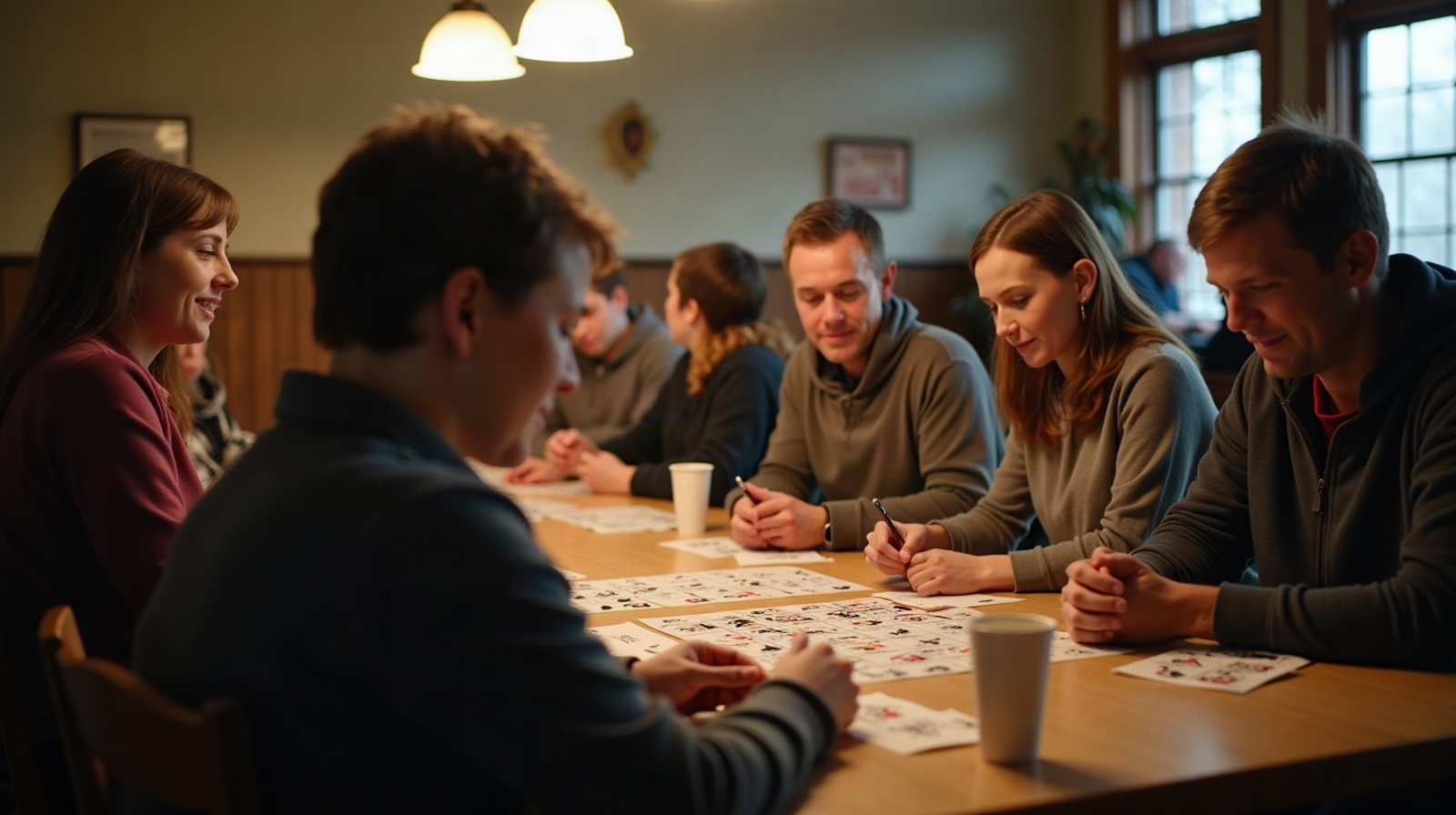
On a Tuesday evening this fall, families filled the tables at Farm House Collective in Riverside for a night of bingo, cards and daubers supplied at the door. It is the kind of low stakes, high fun event that fills community calendars across the Inland Empire, including in Moreno Valley, ten minutes east down the 60 freeway from Moreno Valley City Hall on Frederick Street. Nobody wins money. Somebody wins bragging rights and maybe a gift card. But underneath the daubers and the chatter, a bingo hall is running one of the cleanest demonstrations of probability that ordinary life offers, and it is worth pausing on before the caller pulls the next ball.
Here is the setup. A standard bingo cage holds 75 numbered balls. Each draw is independent, meaning the ball that comes out has no memory of what came before it. If B-12 was called five minutes ago, that fact changes nothing about the odds of B-12 or any other number being called next. The cage does not owe anyone a number it “hasn't used in a while,” and it is not “due” to repeat a lucky one either. This is the same principle at work in a coin flip: after nine heads in a row, the tenth flip is still a fifty-fifty proposition, not a lock for tails.
Human brains resist this. Psychologists call the mistaken belief that independent events must “even out” the gambler's fallacy, and it shows up everywhere people track streaks, from casino floors to sports betting apps to a grandmother at a bingo table insisting a number is overdue. The instinct makes evolutionary sense. For most of human history, patterns in nature genuinely did predict what came next: clouds meant rain, footprints meant prey nearby. Randomness generated by a spinning cage of numbered balls is a very recent invention, and the brain has not caught up.
What actually governs a night of bingo is something different: the law of large numbers. Over a single game, results can look wildly uneven. Somebody's card fills up in twelve calls while another player is still waiting on three numbers when the first shout of “Bingo!” rings out. That unevenness is not a sign of rigging or luck, it is simply what small samples look like. Flip a coin ten times and getting seven heads is unremarkable. Flip it ten thousand times and the ratio will settle in close to fifty-fifty. Play enough rounds of bingo over enough weeks, and the appearance of “hot cards” or “cold nights” smooths out into the plain, unglamorous fact that everyone had a roughly equal shot each time.
This matters beyond the game table. The same reasoning underlies how public agencies handle situations where fairness has to be built in by design rather than by feel, from lottery systems for oversubscribed school programs to randomized selection for limited slots in city services. When a process depends on chance, insisting that a certain outcome is “owed” after a run of bad luck is not a strategy, it is a misreading of what randomness actually promises. It promises fairness over the long run, not compensation in the short one.
None of this makes bingo night any less fun, and there is nothing wrong with feeling a jolt of hope when the caller pulls a number you need. That anticipation is part of the appeal, and mathematics does not require anyone to feel neutral about a game of chance. But it is a useful thing to notice, sitting at a table with a dauber in hand: the ball has no idea what happened five minutes ago, and neither does the universe. Whatever comes next, it comes fresh, every single time.